We welcome applications from the United States of America
We've put together information and resources to guide your application journey as a student from the United States of America.
Overview
Top reasons to study with us
Explore philosophy from a global perspective
Specialist archive resources
Discover Philosophy's practical applications for challenges in the modern world
Change how you think. As a student of History and Philosophy at Lancaster, you’ll build the skills to explore and understand the important challenges that confront our world. This interdisciplinary course combines in-depth historical analysis with the development of high-level philosophical knowledge and skill.
You will learn to hunt down and analyse evidence from a range of sources and periods considering questions of truth, ethics and ambiguity. And you will use philosophy to address theoretical and practical global challenges, developing invaluable skills in critical thinking and the communication of arguments and ideas.
Why study History and Philosophy at Lancaster?
Address the challenges of our world past, present and future, from environmental change to war and conflict, human rights, and scientific revolutions
Apply philosophy in both theoretical and real-world scenarios, addressing global, social and political challenges, and working with a range of problems, texts, challenges and traditions
Engage with texts and artefacts crossing continents and centuries
Draw from multiple philosophical traditions including Western, Continental, Chinese, and Feminist thought
Make your home in a historic city whose castle, cathedral and cobbled streets are part of the stories you’ll discover
Train in high-level analysis, critical thinking and persuasive argument and prepare for an ambitious career
How will I become a historian?
Our team of expert historians will guide you through hands-on training in primary source analysis, with one-to-one advice and feedback from expert historians. From your first days at Lancaster, you’ll build your skills, knowledge and confidence in source analysis, critical thinking and argument.
As a historian, you’ll have honed a special skill: how to seek out evidence, and how to analyse and interpret it. You’ll find evidence from a variety of sources: from laws, letters and diaries to paintings, photographs and maps, and physical remnants such as buildings and burial places. You’ll use these to explore a range of periods and areas, such as the relationship between humans and the environment; experiences of death in past cultures; human rights, and the histories of languages and translation.
Not all historians agree on interpretations of the past. You’ll develop skills in reading historical arguments, uncovering how historians select and present evidence and engage critically with fellow scholars. In the process, you’ll learn how to build your own arguments to engage, inform and persuade – forging essential skills for historical study and for the workplace.
How will I become a philosopher?
Philosophy is an activity, not just a body of knowledge. At Lancaster, we do philosophy together to help you become one of the skilled and self-directed investigators, thinkers, communicators, workers and agents of change our current world needs.
Through regular contact and practice in lectures, seminars and workshops from the very start of your studies; scaffolded project work across your second and third year; and one-to-one guidance in independent study and portfolio work, we will share, test and develop ideas together, and you will develop your own thoughts, interests and creativity.
As a student with us, you will gain both breadth and depth of philosophical knowledge. You will work with philosophers who are actively shaping the discipline in ethics, metaphysics, epistemology, feminist philosophy, philosophy of science, history of philosophy, global philosophy and political philosophy. And you will study a wide range of thinkers, texts, traditions, methods and problems from the past and present of worldwide philosophy: from the good life and justice, to mind and consciousness, to the methods and limits of the arts and sciences.
As you progress through your degree in History and Philosophy, you will develop the skills for increasingly independent and original work. You will learn to engage with both curated topic modules and skill-developing research projects. You will practice critical thinking, debate and communication skills throughout the degree. You will be supported to extend your grasp of the discipline, pursue your own interests and become a skilled philosopher.
Whether you plan to apply your skills and creative intelligence in further academic study or outside the university, we will help you to develop yourself and to be able to make a difference.
What professional experience will I gain?
You will have the opportunity to develop your expertise through expert seminars and debates with guest speakers. Our specialist research centres, provide opportunities for academics, practitioners and students across disciplines to gather for public talks, conferences and training. You’ll also have access to Lancaster University’s rich archival resources that include thousands of items.
What are Lancaster’s research specialisms?
Study with experts who combine world-leading research with a passion for teaching, and benefit from extensive resources and historical archives.
Centre for War and Diplomacy – Experts on History, Law and Politics provide historical context and strategic analysis of geopolitical challenges
Richardson Institute for Peace Studies – The oldest centre for peace and conflict research in the UK, our internship programme gives you the opportunity to work for a range of organisations
Digital Humanities Centre – Uniting excellence in spatial humanities, corpus linguistics and natural language processing
Ethics, Values and Policy Initiative – Bringing together academic experts and policy actors to explore developing an ethics and values-based framework for evidence-based policy making
Interested in study at Lancaster University? Fill in our form to hear more about course information, events and open days.
Tell me more about undergraduate study at Lancaster accordion
Historic Lancaster
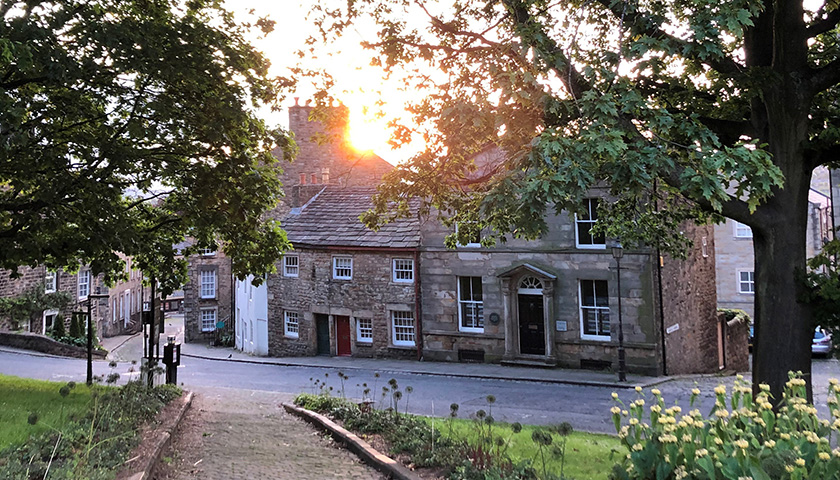
The city of Lancaster and its surrounds are steeped in history. Explore the top historic sites to visit as recommended by members of the School of Global Affairs, from Bronze Age stone circles to Gothic churches, from Norman castles to Civil War fortresses, and from the mills of the Industrial Revolution to marvels of Art Deco architecture.
The study abroad option is an exciting opportunity for anyone who is thinking of working abroad during their career or who simply wants the experience of living and studying overseas as part of their degree.
Often study abroad students describe the year abroad as a “transformative experience”, as it can shape your future career path as well as having a positive impact on your personal development.
On a study abroad course, you'll spend two years at Lancaster before going overseas in your third year to study at one of our international partner universities. This will help you to
develop your global outlook
expand your professional network
increase your cultural awareness
develop your personal skills.
You’ll return to Lancaster for your final year of study in year four.
Host universities
During your year abroad, you will choose specialist modules relating to your degree and potentially other modules offered by the host university that are specialisms of that university and country.
The places available at our overseas partners vary every year. In previous years destinations for students in the Faculty have included Australia, United States, Canada, Europe and Asia.
Alternative option
We will make reasonable endeavours to place students at an approved overseas partner university that offers appropriate modules. Occasionally places overseas may not be available for all students who want to study abroad or the place at the partner university may be withdrawn if core modules are unavailable.
If you are not offered a place to study overseas, you will be able to transfer to the equivalent standard 3-year degree scheme and would complete your studies at Lancaster. Lancaster University cannot accept responsibility for any financial aspects of the year abroad.
Careers
What career opportunities are there with a degree in History and Philosophy?
By studying History and Philosophy at Lancaster, you will graduate with a set of skills that will help open doors to a wide range of career destinations. You’ll be in high demand in roles which require collaboration, communication, leadership skills, and critical thinking and the interpretation of evidence.
Employers seek individuals with the mental agility to tackle and solve complex and novel challenges. They look for independence of mind, and the ability to communicate clearly at all levels. Your degree in History and Philosophy at Lancaster develops all of these skills, preparing you for success in a senior position in a wide variety of employment sectors.
Graduates of this programme might choose to pursue careers in roles such as:
Journalists
Banking and finance
Business management and consultancy
Civil Servant
Book editor
Teacher
Heritage and Museums manager
Policy analyst
Project manager
Public relations specialist
Social researcher
Local government officer
Many of our students take their skills to the next level by continuing with postgraduate studies.
What careers and employability support does Lancaster offer?
Our degrees open up an extremely wide array of career pathways in businesses and organisations, large and small, in the UK and overseas.
We run a paid internship scheme specifically for our arts, humanities and social sciences students, supported by a specialist Employability Team. The team offer individual consultations and tailored application guidance, as well as careers events, development opportunities, and resources.
Whether you have a clear idea of your potential career path or need some help considering the options, our friendly team is on hand.
Lancaster is unique in that every student is eligible to participate in The Lancaster Award which recognises activities such as work experience, community engagement or volunteering and social development. A valuable addition to your CV!
Find out more about Lancaster’s careers events, extensive resources and personal support for Careers and Employability.
Entry requirements
These are the typical grades that you will need to study this course. This section will tell you whether you need qualifications in specific subjects, what our English language requirements are, and if there are any extra requirements such as attending an interview or submitting a portfolio.
Qualifications and typical requirements accordion
AAB
36 Level 3 credits at Distinction plus 9 Level 3 credits at Merit
We accept the Advanced Skills Baccalaureate Wales in place of one A level, or equivalent qualification, as long as any subject requirements are met.
DDD
A level at grade B plus BTEC(s) at DD, or A levels at grade AB plus BTEC at D
35 points overall with 16 points from the best 3 HL subjects
We are happy to admit applicants on the basis of five Highers, but where we require a specific subject at A level, we will typically require an Advanced Higher in that subject. If you do not meet the grade requirement through Highers alone, we will consider a combination of Highers and Advanced Highers in separate subjects. Please contact the Admissions team for more information.
Distinction overall
Help from our Admissions team
If you are thinking of applying to Lancaster and you would like to ask us a question, complete our enquiry form and one of the team will get back to you.
Delivered in partnership with Lancaster University International Study Centre, our one-year tailored foundation pathways are designed to improve your subject knowledge and English language skills to the level required by a range of Lancaster University degrees. Visit the Lancaster University International Study Centre for more details and a list of eligible degrees you can progress onto.
Contextual admissions
Contextual admissions could help you gain a place at university if you have faced additional challenges during your education which might have impacted your results. Visit our contextual admissions page to find out about how this works and whether you could be eligible.
Course structure
We continually review and enhance our curriculum to ensure we are delivering the best possible learning experience, and to make sure that the subject knowledge and transferable skills you develop will prepare you for your future. The University will make every reasonable effort to offer programmes and modules as advertised. In some cases, changes may be necessary and may result in new modules or some modules and combinations being unavailable, for example as a result of student feedback, timetabling, Professional Statutory and Regulatory Bodies' (PSRB) requirements, staff changes and new research. Not all optional modules are available every year.
Why do historians disagree about how to interpret the past? What issues divide them and why do they disagree? Continue your training as a first-year historian and study real-life examples of historical debate introduced by our experts.
If the cornerstone of historical research is handling evidence, why do historians place different values on certain evidence or interpret evidence differently—or miss evidence all together—and how do they build their arguments to come to alternative conclusions?
You’ll develop skills in reading historical arguments, uncovering how historians select and present evidence and engage critically with fellow scholars and how they craft their argument. In the process, you’ll learn from examples how to build an argument to engage, inform and persuade, forging the essential skills of the historian.
We begin your historical training with the cornerstone of historical research: evidence. What counts as evidence? It comes in many forms:
Chronicles and law codes
Letters and diaries written by people in the past
Visual records, from paintings to photographs, film and maps
Aural records such as music and oral histories
The physical remnants of past worlds, from coins to castles and burial places
Each source has a context we need to uncover. Who produced the source and why? Who would have seen or heard it and what was their reaction? From here we can learn what questions to ask of our evidence. How can it illuminate past worlds?
Our expert historians guide you through hands-on training, building your skills in drawing value from historical evidence.
This module explores the lived experience of peoples and nations in the modern age through the emergence of new ideas – including nationalism, capitalism, imperialism, racism, feminism - and, in turn, how those ideas were shaped by individuals, political movements, and events in diverse regions such as Europe, Asia, Africa, and the Americas.
You will explore the dramatic changes that took place across the period, such as enslavement and emancipation, dictatorship and democracy, mass suffrage, war, persecution, and transformations in medical practice and legal systems, including the emergence of the idea of the citizen.
You’ll also consider the histories of those who defied and resisted these ideas, regimes and categorisations in the face of industrial, economic and decolonial transformations. Here you will gain an understanding of how individual and group identities have been forged and contested against a backdrop of turbulent social forces in the modern world.
From questions about truth, justice, and knowledge to debates over freedom, power, and human purpose - how has philosophical inquiry shaped cultural, political, and scientific life across centuries?
In this module you will explore the major ideas and traditions that have guided the development of Western thought. Specific thinkers examined will vary from year to year, but they will include philosophers whose ideas have helped shape philosophical viewpoints, categories and boundaries in the western philosophical tradition. You will be encouraged to think about the problems and limitations of different thinkers’ approaches, and their impact on the way we practice and understand the boundaries and scope of philosophy today, asking questions of them such as:
How did these thinkers conceive of philosophy and its task?
How did they conceive of being and reality?
How did they understand truth and how did they think it could be discovered?
How did they set the agenda for philosophical debates in the West from the past to the present?
By the end of this module, you will have learnt to think with, rather than about some of these influential thinkers, while reflecting on how the concepts that forged the past continue to frame the challenges of our present and the possibilities of our future.
Explore philosophical traditions not usually studied in standard histories of philosophy, and understand what we gain by including them in our interpretation of the history of philosophy.
By engaging with understudied texts and contexts in this module, you will learn to question familiar narratives about philosophical history and to reconstruct alternative lineages and conceptual resources. And by comparing various traditions, you will develop tools to think across boundaries and to put diverse voices into conversation, comparison, and contrast.
You will study at least two philosophical traditions in depth, in dialogue, and in their historical, cultural, and intellectual contexts. The specific traditions covered in the module will vary each year, but may include:
Chinese philosophy
African philosophy
Feminist thought
Women philosophers from specific time periods and locales, such as the Victorian era
Continental European philosophy
Any other tradition that has been historically marginalised in traditional histories of philosophy
You will look at how these different traditions approach a variety of topics, which may include personhood, knowledge and truth, value, morality, and politics, and you will consider how these traditions resist exclusion and broaden our understanding of philosophy and its possibilities past, present, and future.
By the end of this module you will have knowledge of a broader philosophical landscape, and be able to think critically about practices of inclusion and exclusion within philosophical thinking – both as it has been practised in the past, and how it might be practised in the future.
What is real, how can we know, and how can we check our reasoning? In this module you will study philosophical tools for reasoning and arguing (critical thinking) and discover fundamental philosophical questions about knowledge (epistemology) and the nature of reality (metaphysics).
In studying critical thinking, you will learn methods of constructing and analysing arguments and acquire basic logical terminology.
In exploring epistemology, you’ll discuss questions such as: what exactly is it to ‘know’ something? Can we know anything at all? Are there alternative knowledges?
In metaphysics, you will consider questions such as: what is the fundamental nature of reality? How are we to understand cause and effect, necessity and contingency, time and space, personal identity?
You will gain the means to think about some of the deepest and broadest philosophical questions we can ask. And you will be equipped with critical thinking tools to face the contemporary challenges of a globally connected world.
Core
core modules accordion
Who makes History? What drives them to investigate the past? You’ll meet the women and men who have helped shape the discipline of History, delving into their life and works. How did their experiences and opportunities shape their careers and what questions spurred their curiosity? How did they find the sources they would need, and what methods did they use to analyse them?
In exploring their stories, you’ll ask how the place, time and society in which they lived opened opportunities or created obstacles to their careers, how they collaborated with other scholars or carved roles in learned societies or public debate. And you’ll ask why some historians have been heralded as ‘great’ – their names famous, their books widely read – and why others are consigned to the footnotes of the historical profession, their endeavours in the archives unrecognised. What makes a pioneering historian?
Create a portfolio of investigative and critical writing which explores a particular philosophical topic in depth.
In this module you will be guided with expert support from Lancaster philosophers to develop your philosophical and independent study skills. Through deep engagement with a specific topic you will develop your ability to assess philosophical arguments and make independent judgements, informed by reasoning and evidence. You will engage with a text, problem, figure or body of work chosen by an academic within the philosophy team at Lancaster who is a specialist on the topic and work with their expert support, in groups and independently.
Project topics offered each year will be drawn from one or more of Lancaster’s many areas of expertise, such as:
Global philosophy
Comparative philosophy
Ethics
Metaphysics
Political philosophy
Applied philosophy
Social ontology and epistemology
Philosophy of science
Philosophy of mind
The history of philosophy
Feminist philosophy
Continental philosophy
Aesthetics
Completion of this module will equip you with the skills and knowledge you need for further independent writing in your final year of study.
Optional
optional modules accordion
Explore how philosophical thinking can tackle real-world problems, from personal dilemmas to global challenges, by linking abstract ideas to concrete decisions.
In this module you will engage with an applied philosophical challenge, using your philosophical skills to provide compelling reasons in favour of your solution. Through production of a short podcast or in-person presentation, you will also develop your ability to engage in philosophical argumentation beyond the written word. And along the way, you’ll gain the tools to think clearly, act responsibly, and engage thoughtfully with the complex world around you.
Specific topics studied each year draw on Lancaster’s wide range of applied expertise and may include:
Ethics and regulation in traditional and social media, in the era of mass global communication and impact
Bioethical topics such as euthanasia, rationing, ageism, research ethics and public health ethics
Health and illness, the concept of mental health, and the role of lay or patient knowledge versus medical expertise
Ethics in professional and organisational life, including divisions of roles, decent work, unpaid and care work, the rights and duties of corporations and employers and codes of ethics
Study of different scientific methods and their limitations
Throughout this module you will learn about topics in applied philosophy, while developing and practicing some of the many transferable skills that Philosophy graduates bring to a wide range of professional roles, such as critical problem solving, political and ethical reasoning, the clear identification of problems, and the art of communicating potential solutions to diverse audiences.
Explore the two things that make us human – body and mind. Historians once regarded mind and body as the same across time and place. But more recently, historians have challenged this assumption, showing that changing societies have led people to experience mind and body in radically different ways.
You will explore patterns of continuity and change from the medieval to modern periods by investigating key themes such as:
How ideas about mind and body have impacted gender, race and social class
Violence and injury
Sexuality and gender identity
Changing experiences of disability and transformations in attitudes to healthcare
You’ll build the skills to historicise mind and body through innovative methodologies such as:
Disability studies
Histories of health and medical humanities
Gender and sexuality studies
Histories of clothing and bodily adornment
Interdisciplinary approaches including osteoarchaeology
Recent developments in material culture
The study of lived experience
In the nineteenth and twentieth centuries, a new approach to philosophy began to emerge that questioned and interrogated the inherited western philosophical tradition from Plato to Kant. This new approach was later described as ‘continental’ philosophy.
In this module, you will discover some of the key thinkers from this continental tradition of philosophy. The particular philosophers will vary from year to year, but will include pioneering thinkers who have been particularly influential on later continental philosophers (for example, Hegel, Kierkegaard, Nietzsche and Wittgenstein) as well as more recent continental thinkers themselves (for example, Lyotard, Derrida, Levinas, Badiou, Žižek, Foucault, Arendt and Beauvoir). While engaging with their thoughts, we will consider difficult and enduring questions such as:
What is the relationship between history and truth?
How does subjective experience relate to universal truth?
What is the significance of gender and embodiment in philosophical reflection?
What is the role of language and discourse in philosophical claims?
How might we conceive of the relationship between power and freedom?
On completion of this module, you will be able to understand and interpret the central arguments made by these thinkers and to assess their distinctive claims, methods and approaches and their continuing significance for philosophy and for how we ought to structure our societies and lives.
What does it mean to die? Is it frightening? Will I see those I love again? What does it mean to kill, whether an enemy, a friend, or myself? Death is a universal human experience but, as you’ll discover, how we confront it has varied across history.You’ll explore varied experiences of death, from end-of-life care to execution, and from battlefields to pandemics.
Religion can shape beliefs and customs, from the theology of the afterlife to funerary rituals and the treatment of the corpse. Yet at the margins have always lain a shadowy world, where the restless dead return, the living seek to summon the departed, and the despairing take their lives.
You’ll discover the different means of investigating death, from the chronicles that describe the walking dead, to the archaeology of burial practice, and from murder trials to palaeogenetics, unlocking the passage of disease.
To what rights are humans entitled? How are those rights balanced with the rights of other organisms and the environment? How are they balanced with the needs of societies and governments? The protection of human rights has been used to justify international conflict and military intervention to save lives, yet human rights critics have argued that they are a form of cultural imperialism limiting the sovereignty of local populations.
You will explore the codification of rights, from Magna Carta and the Universal Declaration of Human Rights to the Geneva Conventions, and how questions of rights have manifested in movements for decolonisation and self-determination, debates on the use of capital punishment, and campaigns for gendered, disability and same-sex relationship rights. You’ll also explore how societies have considered rights in relation to landscapes, from the right to roam to the protection of spaces, from medieval forests to the creation of national parks.
Critically engage with questions and debates about our socially connected lives and the ways in which we interact and act on the world through language and communication, individually and as a society, to shape knowledge and reality. In this module you will gain the skills and insight to ask questions which change each year but may include:
How does communication work in our individual and collective lives?
How might certain kinds of communication bring about ethical and political change (for example, by making something permissible or changing the boundaries of acceptable political discourse)?
Are lying and other kinds of deception permissible, and if so, when and for whom?
What does freedom of speech really mean, and how might duties and rights differ in this space for citizens, for the press, for politicians, for academics, and on social media?
How can collective knowledge practices exclude or harm, do we have duties to address these problems, and what might work to do so?
What is the nature and appropriate regulation of propaganda and hate speech?
What are the ways in which patterns of attention and exclusion or inclusion in who we listen to and develop knowledge with may have ethical and political implications?
What communicative protest and speech acts are legitimate in a democratic state?
You will leave this module with a better understanding of how practices of knowledge creation and participation, and of language and communication, may actively shape and determine the boundaries of our world, and with the skills to critically examine these forces in action across the media, social media, politics and society.
What does it take to have a mind? How does science work? Does human reason equip us to understand the external world? In this module we explore the nature of consciousness and reality, and the methods by which we understand them, focussing on key debates in the philosophy of mind and philosophy of science.
In the first part of the module, you will explore what it takes to have a mind, examining and critiquing some of the wide range of answers philosophers have offered to this intractable problem. Questions you will investigate include:
What is the relationship between the mind and the brain?
How do animal minds or artificial intelligence fit into our understanding of thought and consciousness?
Can science ever provide us with a full understanding of how consciousness is possible?
The second part of the module turns to the nature of science itself. Modern science is often regarded as our most reliable guide to reality, but what justifies this status? In investigating the nature of science, you will learn about some of the most influential twentieth-century accounts of scientific method and theory-testing. Questions you will address include:
How does science differ from non-science?
Is there a scientific method?
Should we believe in unobservable entities posited by scientific theories, such as quarks or superstrings?
What are limits of scientific and rational inquiry?
Through wrestling with debates about the nature of consciousness, science, and the extent to which we can understand reality you will leave this module equipped with a greater understanding of some of the most difficult and enduring challenges in philosophy: what it is to be human, to have sentience, and how should we understand the vast body of scientific knowledge that shapes our collective world?
Global and local political and economic affairs raise complicated philosophical issues. While political theory and philosophy often focus on normative questions – such as the nature of justice, freedom, or legitimacy – this module centres on the epistemological and methodological challenges that underpin our understanding of political and economic life. These challenges are no less important for how we think about contemporary societies and the difficulties they face and are, as you will discover, closely connected to more normative questions.
Concepts such as democracy or autocracy, money, taxation and national debt, power and economic growth – all are complex and contested:
They raise metaphysical questions: what sorts of ‘things’ are they?
They pose epistemological challenges: how can we know or measure them? Is it possible to study them without making assumptions about values?
They provoke broader considerations: how do large-scale political and economic phenomena relate to individual people and their activities?
Through considering these questions on this module, you will gain an understanding of the special challenges involved in knowledge of our social, political and economic systems, and how philosophical thinking complements the tasks of political science and economics.
Explore the links between humans and their environments around the world from the medieval period to the modern era. Examine how people have understood nature and their place within it over time and across cultures, investigating climate change, environmental disasters and massive landscape transformations.
You’ll situate the natural world as both an agent of change and a system that humans can alter on many scales, developing skills in navigating complex human-environment interactions. You will encounter a range of sources, from texts to images and environmental data, and learn how to analyse them, including through digital methods.
With these skills, you’ll explore regional case studies of environmental impacts on humans and human alterations of the environment, from the impact of warming periods and the Little Ice Age to the transformation of colonial landscapes, the exploitation of forests, minerals, and water and the effects of urbanization.
20th-century British history is largely a story of change. The impact of democratisation, war, economic decline, the loss of empire, and internal fragmentation has resulted in a nation seemingly in constant flux, often unsure of its identity and its values.
In this module you will explore the patterns of social, economic, cultural and political change which have most affected the lives of the British since 1900. The overarching themes are the formation and reformation of identities based on class, gender, race, empire, nation, and the dual process by which the British were integrated into the state as citizens, and into the market as consumers. As well as being introduced to the key historiographical debates, in this module you will be encouraged to explore the subject through an eclectic mix of primary sources, including cartoons, posters, fiction, press reports, and advertisements.
Discover how wars are among the most important drivers of historical change. They have transformed states, societies, borders and landscapes, as well as ideas, identities, and worldviews.
The decision to go to war is rarely taken lightly, but the mechanisms and norms for doing so have varied greatly over time. How peoples mobilize themselves for conflict has likewise been shaped by ideas about rights, responsibilities, and roles, ideas sometimes rooted in shifting concepts of gender and racial ideologies.
War is also a crucible of scientific and technological change. From the longbow to the machine gun, and from photography and reconstructive surgery to the atomic bomb, war has stimulated scientific and technological innovation while unleashing its most destructive forces.
By exploring war and its legacies in all its complexities, you’ll see it not as a unique form of human endeavour, but as a realisation of broader social, cultural, and intellectual forces.
Explore how language is used to interact with others, form social groups and shape society. In this module, you will examine how communication functions socially, from the persuasive language used by politicians and advertisers to the way social organisation is reflected in and reinforced through casual conversations among friends.
You’ll draw on different models in linguistics to explore the way language is used and organised to achieve social goals. This includes:
Using principles of systemic functional grammar to identify who is represented in texts and how,
Conversation analysis to uncover the structure and management of conversation
Methods of visual analysis to consider non-linguistic meanings
By the end of this module, you will become more confident in analysing texts and understanding their functions. You will see everyday texts, such as a phone call with a family member or a letter from your GP, in different light because you will understand the features and structures of language that help to organise society.
Hone a strong sense of purpose and gain the satisfaction of applying your skills and knowledge to a community, charity or student-led initiative.
Your challenge will be to take responsibility for arranging and completing a voluntary or fundraising activity—locally, virtually or during vacation periods at home. You will need to show that you have made a positive difference through this activity.
In class, you will be asked to reflect on this experience and explore the wider social impact of the work. In doing so you will build your confidence in your ability to contribute meaningfully to society through your future personal and professional path.
Move beyond introductory concepts to explore film theory in depth, examining how films construct meaning through form, representation, and audience engagement.
You will critically assess cinema’s relationship with artistic expression and spectatorship, engaging with complex debates that have shaped film scholarship since the medium’s inception. Focusing on advanced theoretical analysis, this module equips you with the conceptual knowledge and critical vocabulary to interpret films using semiotic, psychoanalytic, formalist, philosophical and cognitivist approaches.
You will explore key concepts such as cinematic modernism, subjectivity in film perception and cinema’s evolving relationship with philosophy. The module fosters independent critical engagement with the works of influential theorists, deepening your understanding of theoretical frameworks.
By applying these perspectives to a range of case studies, you will refine your ability to conduct detailed textual analysis. By the end of the module, you will have developed sophisticated theoretical and analytical skills essential for higher-level film study.
In this examination of the evolving landscape of global power, we identify the forces challenging the world’s leading nations and explore the fluid nature of influence in the 21st century.
We will analyse the shifting balance of power, explore the relative decline of traditional superpowers and the simultaneous rise of new actors on the global stage.
You’ll be encouraged to consider how economic, military, and cultural influence is being reconfigured in a multipolar world, reshaping traditional understandings of world order. Crucially, we will also analyse the internal and external pressures these powers face, form rising regional actors, to the evolving nature of global threats, and the erosion of traditional power structures.
Through different case studies and theoretical frameworks, you will gain a nuanced understanding of the complex interplay between rising and established powers and the implications for global stability and future orders.
The future of state-funded welfare is one of the most pressing social questions of our time. This module explores the history, purpose and politics of welfare states, examining what social welfare is, who it is for and how it should be funded and delivered.
You will consider the social and political debates that have shaped social welfare and trace their development over time. Topics covered may include education, health, housing, social security and unemployment. You will explore how welfare systems are funded, managed and organised and analyse the impact of social welfare cuts on poverty and social inequality.
The module also examines the moral and political tensions within welfare debates, such as distinctions between ‘deserving’ and ‘undeserving’ recipients. Engaging with diverse sources—including academic texts, policy reports, and media—you will develop critical insights into the past, present and future of welfare provision.
In this module you will explore how issues concerning gender, womanhood, and sexuality have played out in relation to culture and religious traditions across the world and through time. You will be encouraged to question preconceptions and examine – through an analytical gender lens – how practices of piety have both empowered and enabled, as well as controlled, women in expressing their experiences, identities, and agency. You will explore how religious texts, rituals, and institutions have constrained or facilitated gendered expressions using case studies from Hinduism, Islam, Christianity, and indigenous traditions.
A focus on the subcontinent may examine sacred womanhood, investigating connections between power, antinomianism, transcendence, and female power-essences embodied in wild goddesses, women philosophers, and mystics. Alongside gender, womanhood, and femininity, you may also explore conceptions of transgenderism in religious imagery, mythology, and counternormative narrative traditions in which patriarchal hierarchies are questioned and subverted.
Within the context of Islam, you may consider how women have historically occupied roles as transmitters of hadith (prophetic tradition), jurists, and theologians, while also being subjects of legal, theological, and mystical discourses that both regulate and sanctify female bodies. Alongside this, you may explore the rich traditions of female piety and mystical experience within Sufism, where women have served as spiritual guides, poets, and saints, often occupying forms of authority that transcend formal hierarchies.
The module may also include a comparative focus on other religious traditions, bringing new questions to light about how gender and power intersect across different cultural contexts. Drawing on feminist, postcolonial, and decolonial approaches, you will examine global parallels in how women have negotiated, subverted, and reinterpreted normative gender frameworks in religions – whether through embodied practices of piety, counter-normative narrative, or decolonial feminist frameworks.
Spanning the linguistic and cultural contexts of France, Germany, Spain, and the Sinophone world, this module explores how language functions as a primary site of identity formation, political contestation, and cultural power. You will explore various topics, such as:
Language standardisation and stigma
Minority and regional languages
Multilingualism and migration
Linguistic nationalism
Colonial and postcolonial language politics
The relationship between language, class, and social reproduction
Through sociolinguistics, cultural theory, and the analysis of film and literature, you will investigate:
The ways in which language policies reflect and reproduce relations of power, and how their human costs and exclusions are narrated from the point of view of language users in film and literature
How literary texts and films represent linguistic variation, regional difference, and cultural belonging through visual and narrative strategies
The relationship between linguistic prestige and social inequality, and how minority voices are marginalised or amplified
How colonial and migratory histories have shaped the linguistic landscapes of France, Germany, Spain, and the Sinophone world, and how individuals within those landscapes receive and negotiate that inheritance
The ways in which regional and minority languages (Alsatian, Catalan, Galician, and others) are negotiating their place within, and against, the dominant language policies of their respective national contexts
How diasporic and multilingual communities navigate questions of linguistic identity and belonging, as lived experience and as artistic subject matter
What the comparative study of language politics across different cultural contexts reveals about power, resistance, and cultural survival
This module equips you with the skill set to analyse films from the UK, Europe, Latin America and China in their socio-historical contexts through core themes, typically migration, the environment, artificial intelligence and gender. You will make use of the ‘language of film’ (cinematic techniques and genre conventions) to explore migration, for example, through sociological concepts of human movement, the role of documentary in representing beneficial and detrimental approaches to the environment, the concept of ‘artificial culture’ through the blurring of human/non-human boundaries in film, and the relationships between masculinities and different forms of violence on screen.
In the process, the following questions, among others, are addressed:
How do films deal with the complexity of topics relevant to modern society such as migration, the environment, artificial intelligence and gender?
Do films which deal with these topics entertain viewers, instruct them, or both?
How might the aims of these films be obstructed or enhanced?
What role do production limitations and opportunities have to play?
In what ways are cinematic techniques instrumental in our interpretations of those topics?
How relevant are genre conventions and expectations to our readings of such films?
What can be learned from both traditional and radical forms of cinema?
What can we learn by applying lenses such as structural violence, community-formation and the gendered gaze?
Explore how ideas can be developed into real-world projects with lasting value. Through hands-on collaboration and problem-solving, you will develop innovative projects, learn how to bring ideas to life and explore ways to sustain them.
Whether you are working in a team or individually, you will be encouraged to experiment with different approaches to making a difference in artistic, cultural, social and community spaces.
You are invited to collaborate in an interdisciplinary team with other students as you explore major global challenges such as climate change, inequality or emerging technologies.
Throughout the module you will examine how the humanities, arts and social sciences contribute to understanding and addressing complex issues. Classroom discussions and activities focus on the process of identifying problems and considering innovative, ethical responses, while helping you to consider and articulate the relevance of this work to your personal and professional development.
Core
core modules accordion
In your third year you will study at one of our international partner universities. This will help you to expand your global outlook and professional network, as well as developing your cultural and personal skills. It is also an opportunity to gain a different perspective on your subject through studying it in another country.
You will choose specialist modules relating to your degree and potentially modules from other subjects offered by the host university that are specific to that university and country.
The availability of places at overseas partners varies each year. In previous years destinations for students in the Faculty of Humanities, Arts and Social Sciences have included Australia, United States, Canada, Europe and Asia.
Optional
optional modules accordion
As an advanced undergraduate historian, you’ll identify a historical topic that excites you and where you can make your own contribution to historical understanding, gaining the satisfaction of forging your own research project.
To guide you throughout, you’ll be allocated an expert historian as your supervisor, with whom you’ll meet regularly to discuss your choice of topic and research design, your hunt for primary sources and your analysis of secondary literature. With their support you’ll research and write a dissertation: a written research project exploring a challenging historical problem.
Research for dissertations involves building systematic understanding of your topic and engaging with the latest research, forming critical evaluations of historians’ arguments and deploying the skills you’ve been developing so far in source analysis to identify and address historical problems. You’ll hone your expertise in building a sustained interpretation and writing effectively and engagingly to inform and persuade.
In this module you will develop either a single extended piece or a portfolio of independent philosophical work. This may take the form of either (1) a philosophical dissertation or (2) a communication and engagement portfolio of outward-facing philosophical work targeting a diverse range of audiences.
1) Dissertation
Independent research and sustained long-form writing making up the core of professional academic philosophical study. With the Dissertation option, you have the opportunity to demonstrate your research and writing ability via completion of an independent dissertation project.
You will identify a specific philosophical topic from the wide range of research specialisms within Philosophy at Lancaster and, together with your allocated dissertation supervisor, develop a clear research question. you'll then engage with relevant primary and secondary texts to construct a compelling philosophical argument over a sustained piece of writing.
2) Communication and Engagement Portfolio
From public philosophy articles and podcasts to social media posts, science communications and policy advisory notes, academic philosophers regularly engage with, inform and persuade audiences beyond academia. This requires clear, compelling arguments and an understanding of the target audience.
With the Portfolio option, you will apply the philosophical skills and knowledge gained during your degree to communicate ideas to wider audiences. Working with your supervisor, and choosing from among the wide range of philosophical specialisms at Lancaster, you will develop a philosophical claim or perspective on a topic, engage in structured workshops to practice writing and presenting for diverse platforms, discuss your work with peers, and complete a portfolio of public-facing philosophy pieces across multiple media.
____
Whichever option you choose, this module is an opportunity for you to complete your undergraduate student journey by demonstrating that you can expand on the knowledge base you have developed through your degree, and use the philosophical skills your programme has helped you develop, to produce your own independent work in philosophy. In doing so, this module will help you demonstrate, and further develop, your advanced research and communication skills, preparing you for both further academic study in philosophy and for professional roles that require skills in research, critical thinking and independent thought.
In this module you will develop either a single extended piece or a portfolio of independent philosophical work. This may take the form of either (1) a philosophical dissertation or (2) a communication and engagement portfolio of outward-facing philosophical work targeting a diverse range of audiences.
1) Dissertation
Independent research and sustained long-form writing making up the core of professional academic philosophical study. With the Dissertation option, you have the opportunity to demonstrate your research and writing ability via completion of an independent dissertation project.
You will identify a specific philosophical topic from the wide range of research specialisms within Philosophy at Lancaster and, together with your allocated dissertation supervisor, develop a clear research question. you'll then engage with relevant primary and secondary texts to construct a compelling philosophical argument over a sustained piece of writing.
2) Communication and Engagement Portfolio
From public philosophy articles and podcasts to social media posts, science communications and policy advisory notes, academic philosophers regularly engage with, inform and persuade audiences beyond academia. This requires clear, compelling arguments and an understanding of the target audience.
With the Portfolio option, you will apply the philosophical skills and knowledge gained during your degree to communicate ideas to wider audiences. Working with your supervisor, and choosing from among the wide range of philosophical specialisms at Lancaster, you will develop a philosophical claim or perspective on a topic, engage in structured workshops to practice writing and presenting for diverse platforms, discuss your work with peers, and complete a portfolio of public-facing philosophy pieces across multiple media.
____
Whichever option you choose, this module is an opportunity for you to complete your undergraduate student journey by demonstrating that you can expand on the knowledge base you have developed through your degree, and use the philosophical skills your programme has helped you develop, to produce your own independent work in philosophy. In doing so, this module will help you demonstrate, and further develop, your advanced research and communication skills, preparing you for both further academic study in philosophy and for professional roles that require skills in research, critical thinking and independent thought.
The traditional historiography of the Cold War focused predominantly on the United States and the Soviet Union, and the European theatre of the conflict. This module, in contrast, offers you a different, less Western-centric view of the Cold War. You will study the impact of the East-West struggle in Asia, the Middle East, Africa, and Latin America, and how the course of the Cold War was affected by conflicts in the Global South. Thereby, you will learn that the Global Cold War was not only dominated by the two superpowers, but was also heavily influenced by Third World actors and lesser Cold War powers such as the People’s Republic of China.
The study of the Global Cold War is currently the most dynamic field in Cold War History and, probably, even in International History more generally. As a result, you will be able to engage with a vast body of international literature, and have the opportunity to carry out primary sources-based research. This is rendered possible by the availability of specific Cold War History document collections, national collections of diplomatic documents, as well as digital archives and document collections.
Uncover the origins of modern consumer society in Britain. In the century from the abolition of advertising tax in 1853 to the birth of commercial television in the 1950s, advertising became a pervasive feature of modern life, and Britain became a nation of consumers. Through a range of sources, including press reports, social surveys and – of course – advertisements, you’ll investigate the impact of new shopping environments like the department store and the supermarket, and the rise of ethical consumerism.
Advertising is political, and you’ll also examine how it helped Britain win two world wars and market the Empire to its citizens. By the end of the module, you will understand how advertising sells us much more than simply clothes or food, how it shapes the way we view gender and race and how it creates support for a market economy based on the principles of freedom and choice.
Examine how cogent issues in crime, justice and punishment have been treated historically from the eighteenth century. Taking advantage of online historical datasets, including Digital Panopticon and Old Bailey Online, you will be introduced to the vast range of historic criminal justice records.
On the module, the classroom becomes the archive. You’ll get hands on with primary sources evidencing the social and cultural history of modern Britain, and act as Digital Detectives to gather evidence to unlock the world of Victorian crime and punishment.
By using digital approaches to this evidence, you will be able to navigate a history from below and explore the impact of crime and injustice on diverse social groups including women, the working classes, migrants and youth. You’ll explore historical experiences of crime, justice and punishment both at scale and at the level of the individual in its fullest evidential context.
Soviet history is often told through the prism of totalitarian oppression, but beneath layers of state control a vibrant dissident movement was active. In this module, you will explore the breadth, depth and complexity of the Soviet dissident movement and critically analyse the impact that they had on the wider world.
You will explore the nature of political life in the Soviet Union, ranging from the labour camps under Joseph Stalin, to the use and abuse of psychiatry under Nikita Khrushchev and the silencing of dissidents under Leonid Brezhnev. You’ll also consider the role dissidents played in the collapse of the Soviet regime and the position of dissidents in contemporary Russia.
By focusing on political dissidents in the Soviet system, you will critically assess how totalitarian governments function, how opposition movements operate and how the international community responds to this persecution.
Gain an in-depth understanding of this dark chapter of Spain’s history. On the 17 July 1936, a group of military generals launched a coup against Spain’s democratically elected Second Republic. The following three years witnessed a bitter struggle to determine the future of Spain. The Spanish Civil War has been dubbed a ‘dress rehearsal’ for the Second World War. General Francisco Franco relied on Hitler and Mussolini to defeat his domestic opponents, while the Republic received support from Soviet Russia.
Yet the conflict had important local dimensions. Spanish socialists, communists, anarchists, liberals and feminists fought to the last against Franco’s ‘Nationalists’. Following his victory in 1939, Franco outlived his international fascist allies by decades, the legacies of which remain keenly present within present-day Spain.
Drawing on diverse primary sources—including autobiographies, oral histories, films, songs, and political speeches—on this module you will develop advanced skills of historical analysis.
Explore the history of South Asia from the abolition of sati to the death of India’s first Prime Minister, Jawaharlal Nehru. You will consider the social, cultural and political histories through which the idea of India was expressed and contested.
You will examine the debates and rebellions through which the European colonial project was resisted and South Asian identities were expressed and cohered. You’ll begin by considering how, in the nineteenth century, the translations, interpretations and classifications of subcontinental history, society and language were created.
How were ideas of identity, community and freedom formed in response to and against the incursion of European power in the region? Subsequently, how did the idea of the nation coalesce into something beyond Empire to create not one, but two nations: India and Pakistan?
Explore British foreign policy and the country's broader engagement with the wider world throughout the twentieth and early twenty-first centuries. Considering broad debates concerning the decline of British power during this period, you will investigate the central themes that defined Britain's overseas policy in this era, including the impact of the World Wars, the loss of Empire, the 'special relationship' with the United States, and European integration.
In exploring these themes, you will consider how people from a variety of different perspectives (British and foreign, politicians, journalists, novelists, activists) conceived of Britain's world-role since the First World War.
In order to incorporate this variety of perspectives, you will draw on a large range of sources, including newspaper articles, novels, poetry and films, as well as traditional archival sources like official government documents, diaries and memoirs.
The thirteenth century brought rebellion against a tyrant, then a revolution: a party seized power from the king to govern England. This period is hailed as the foundation of democracy – but the reality is darker. Religious leaders were empowered to punish kings, rebels fought as crusaders, and people killed and died for a political cause.
You’ll explore events including the making of Magna Carta, the 1258 coup, and the Battle of Evesham that ended England's First Revolution. You’ll meet queens like Eleanor of Provence, leading knight William Marshal, and Pope Innocent III; tyrannical and hapless kings; Simon de Montfort, the revolution's leader; and the low-born people who flocked to his banner.
You’ll investigate their stories through letters, testimonies, and eye-witness accounts, and challenge historical interpretations of this era. What moves women and men, poor and rich, to risk their livelihoods, take life and give their own to decide who rules?
With the blurring of the Home and Battle Fronts in Britain in the Second World War, the conventional wartime gender contract — in which men fight to protect the vulnerable at home and women keep the home fires burning — was challenged. In this module you will examine how war was experienced by those who conformed to and those who challenged gender norms, by those included in the war effort and those who stood outside it.
You’ll consider different categorisations of experience (military/civilian; home front/ battle front; male/female) and how historians have grappled with key concepts including the People’s War and hierarchies of service. Through a wide range of primary sources, including autobiographical materials, poems, photographs, films, parliamentary minutes, newspapers, posters and cartoons, you will seek to understand individual and collective experiences of the war and their gendered dimensions.
Colonisation fundamentally transformed Jamaica’s paradisical environment. In this module, you will gain a detailed understanding of how this process occurred. You’ll begin by studying how the first colonists comprehended the New World environment and the importance of that environment for shaping settlement. You will then study how settlers exploited the Jamaican environment using enslaved African labour.
In the concluding section, you will examine how colonists sought to mitigate the devastating effects of plantation agriculture through nascent environmentalism. You’ll study this fascinating history using a diverse array of primary sources and by reading deeply in environmental history. In the assessment, you will be able to undertake your own research in environmental history. You will emerge from this module with a detailed understanding of Jamaica’s natural history and the field of environmental history more broadly.
Explore the development of the Italian cities across one of the most significant periods of medieval history. Between 1100 and 1350, northern Italy was divided into sixty ‘city-states’ governed by their citizens through assemblies and shared public office. Italian merchant-bankers grew so rich that they lent money to kings and popes, and used their wealth to transform cities into works of art, encouraging a period of cultural flourishing later called the Renaissance. But beyond this splendour lay a darker reality of economic exploitation, political exclusion and violence that eventually proved fatal for this system of self-government.
In this module you will explore themes such as coexistence and violence, participation and exclusion, law and good government. You’ll examine sources ranging from legal documents to frescoes, and from literature to architecture. Meanwhile, you’ll ask a question that remains important today: what does it mean to be citizens in a plural and increasingly unequal society?
From music, film, and television to sports, fashion, and digital media, explore how cultural texts raise philosophical questions about identity, morality, power, and meaning, and examine how popular culture both reflects and shapes the way we understand ourselves and the world around us. In this module you will look at how philosophers have understood the production, circulation and reception of popular culture, and how it bears on our own autonomy, agency, power, and identity.
You will study themes which may include:
Philosophical approaches to mass culture, cultural value, art, and aesthetic judgement
Authorship, mass production, genre, kitsch, remix, and the ontology of reproducible artworks
Identities, stereotypes, cultural appropriation, objectification, and other political issues in regard to popular culture and mainstream media
The Frankfurt School on the culture industry and the critique of popular music
Pragmatist, analytic and continental arguments for the aesthetic and social value of popular music, film, television and other forms
Philosophical analysis of selected cultural artefacts as case studies – songs, films, novels, and visual art
In studying this module, you will gain an understanding of how philosophy provides tools for interpreting the stories we collectively tell and consume – and how those stories, in turn, influence our sense of self and the very fabric of the societies and world we inhabit.
Engage with cutting-edge philosophical research, working with an academic philosopher on the topic of their live philosophical project and expertise. In this module you may be:
Reviewing and critically commenting on the chapters of a manuscript
Reading an academic’s recent publications and coming up with further questions and challenges to build on their ideas
Discussing your module supervisor's new research and it's relevancy to contemporary philosophical debates
In student-led and discussion-based workshops you will present your own summaries and arguments, take part in guided debates, and work on the challenge of your final written piece: a paper which is not only informed by, but may itself eventually inform, current debates within the discipline. In doing so you will be joining the practice, shared by all professional philosophers, of contributing to the understanding and development of the field itself.
The specific question/s you will work on will vary year by year, but will be drawn from the interests and expertise of Lancaster's philosophy staff. They might include, for example:
What is the best life for a human being
What do psychiatric diagnoses mean
What is personhood and what entities can be persons
How can we respect human autonomy while making public policy
What can combatant experience teach us about the ethics of war
One or more options will be offered each year.
In studying this module, you will deploy the skills you have developed in the first two years of your degree, gain in-depth knowledge of an important area of contemporary philosophical inquiry, and further sharpen skills in argument and critique – critical skills for both postgraduate study and a range of post-study careers.
Engage with a significant philosophical text or collection of texts, working with an academic philosopher on the topic of their live philosophical project and expertise. In this module you will:
Read deeply
Develop interpretations
Make reasoned assessments
Find and engage with secondary literature
Contribute to contemporary understanding and critique of your text(s)
In student-led and discussion-based workshops, you will present your own philosophical interpretations and arguments, take part in guided debates, and work on a portfolio of critical readings. In doing so you will be joining the practice, shared by all professional philosophers, of contributing to the understanding and development of the field itself.
The specific text(s) you will work on will vary year by year, but will be drawn from the interests and expertises of Lancaster philosophy staff. They might include, for example:
Work by philosophers whose work had, and continues to have, major impact, such as Immanuel Kant, John Stuart Mill and Harriet Taylor Mill, Hannah Arendt, J. L. Austin, or Iris Marion Young
Work by significant contemporary philosophers such as Miranda Fricker, Peter Railton, Martha Nussbaum, or David Lewis
Work from within a specific philosophical tradition, such as classical or modern Chinese philosophy, or work by nineteenth-century women philosophers.
One or more options will be offered each year.
In studying this module, you will deploy the skills you have developed in your first two years of study, gain in-depth knowledge of an important area of philosophy, and further sharpen your skills in reading, interpretation, and thoughtful response – critical skills for both postgraduate study and a range of post-study careers.
Interconnected global crises and states of ‘polycrises’ or ‘wicked problems’ impact upon the daily lives of millions of people across the globe. Environmental, financial, security, diplomatic, political and military concerns all pose acute problems of knowledge and understanding, require individual and collective action, and raise questions around duties and rights for addressing multi-faceted complex problems.
Philosophical reasoning can play a key role in helping individuals, politicians, states and societies navigate these challenges, and in shaping and critiquing the principles for taking action. In this module you will actively work on developing your own philosophical contributions to addressing global crises, studying topics which may include:
Themes from social epistemology, including the difficulty of creating shared knowledge in the face of societal challenges; institutions for scrutinising as well as disseminating knowledge claims; the need for diverse perspectives on so-called wicked problems, and also the challenges of combining and reconciling these.
Themes from the philosophy of collective action and metaphysics, including the ways in which human beings can cooperate outside of formal institutions and create new institutions to address societal and international problems, as well as problems of diffuse responsibility amid complex or changing social structures.
Themes from political philosophy, such as the difficulties and strengths of democratic institutions and the compromises they require; the challenges of reconciliation and institution-building after war and conflict; the challenges democracies face in light of populism, authoritarianism, corruption in the democratic process, and problems of disinformation.
Over the course of this module you will learn how different philosophical approaches can help us to think our way through our own responsibilities in these times, offering different perspectives on the various roles we can play in surviving, and even flourishing, in times of global crisis.
Politics is one of the most widespread and diverse phenomena of human experience. Yet it is often studied by relying on concepts, theoretical resources, and methodological approaches derived from a single intellectual tradition. This module seeks to reverse this trend by introducing you to global philosophical perspectives emanating from different intellectual traditions on a particular topic.
The philosophical traditions with which we engage will vary from year to year, but may include Chinese, Continental, Analytic, African, Feminist, Postcolonial, and/or Decolonial perspectives. The topics that we look at will also change but may include one or more of the following:
Democracy
Modernity
Secularism
Pluralism
Rights
Political legitimacy
We will consider how the theme(s) we focus on has or have been construed in different settings, and we will inquire into how these different construals can help us achieve a better understanding of today’s sociopolitical landscape, while also providing new perspectives on how to tackle some of the most pressing political problems of our times.
In addition to learning about different philosophical traditions, you will also reflect on the challenges of studying philosophy comparatively and engaging with philosophical traditions that derive from different cultural settings, developing a broader critical understanding of political community and life.
For centuries, the coastal and interior regions of West Africa enjoyed extensive trans-Saharan trade as part of the Silk Roads network. The arrival of Portuguese traders in the mid-fifteenth century eventually redirected some of that trade, giving rise to the transatlantic slave trade that forcibly transported more than 11 million Africans to the Americas over four centuries. Often marginalised in histories of transatlantic slavery, the spiritual, political, and economic fabrics of West African societies were nevertheless irreversibly ruptured. How were they remade, and who did the work of ‘life-making’? What did the struggle for survival look like in Angola, Cape Verde and Guinea-Bissau, where the threat of violent kidnap, enslavement, and forced migration was omnipresent? And how did West African family life, slaveries, and spiritualities challenge and shape colonial ideas of race and gender? This is an exciting opportunity to read a decolonial history of transatlantic slavery from West African perspectives.
In this module, you will gain a deep understanding of sixteenth-, seventeenth-, and eighteenth-century Portuguese-speaking West African history as a global history. You will develop expertise in, and experience of, deploying established techniques of analysis from cultural, art, political, global, economic, gender, and business history. Making use of a range of primary and secondary sources in translation, you will be challenged to digest and critique cutting-edge research in African history.
Why does History matter? What does it contribute to our world? Challenge yourself to consider how our discipline is applied.
Beyond working in universities, historians are active in public debate and influence the policies of institutions and governments on matters from the memorialisation of historic figures and institutional links with the Transatlantic Slave Trade to geopolitical threats to UK security. They collaborate with museums, helping visitors engage with material remains of the past, and write books for a wide public readership.
You’ll develop a critical awareness of your discipline and gain confidence in articulating its significance in our world. You’ll also contend with the subjective use of History: how political leaders have co-opted stories of the past to justify war and conquest, and ideologically driven groups claim historical legitimacy. What role should historians play in shaping how our understanding of the past influences the present?
Explore the history of Victorian Britain and its global encounters through the prism of the body.
Embodiment was central to the way Victorians thought about themselves and others. From sexology to racial science and from sport to war, Victorians sought to make sense of their complex and globalised world by reading character from the body, ascribing values, both positive and negative, to the bodies of others, be they colonial subjects, the working class or queer men.
By studying the history of the body, you will gain new insights into this fascinating period of British history as an age of both remarkable optimism and profound anxiety. Drawing upon a rich and evolving historiography, you will engage with cutting edge and inclusive scholarship that considers how the body became the locus of profoundly unequal power relations and a vehicle for deep-seated prejudices that continue to shape our world today.
Study conceptual questions about the nature of power, justice, freedom and the state – and normative questions about the kinds of political structures we should adopt. This module builds on previous modules on political philosophy and theory by offering the opportunity for advanced study in the area.
We will consider questions such as how can democracy safeguard our interests, and how might it endanger them? What is equality, and is it desirable? What does it mean to claim that we have ‘rights’?
You will read contemporary and historical texts in depth and debate their implications for modern governance and society. You’ll gain a deep understanding of the theories behind key issues in contemporary politics, equipping you to analyse complex political concepts. You will also develop essential interpretive and argumentative skills, enabling you to assess competing viewpoints and contribute thoughtfully and persuasively to ongoing discussions about politics.
An important exploration of the key issues and challenges facing contemporary democratic states and movements in the 21st Century.
Arguably, modern democracy faces multiple challenges such as:
The rise of populist movements
Democratic backsliding
Declining public trust in leaders and political institutions
Globalisation and transnational government
New forms of authoritarian leadership
Increasing repression of dissent and protest
Taking a comparative approach, we will explore how these evolving challenges have impacted the politics of both democratic and authoritarian states, and we will evaluate the effectiveness of the strategies that have been taken to address them.
Using the skills in both research and comparative analysis that you have developed during the programme, you will carry out your own independent research and contribute to contemporary academic debate on the prospects for democracy.
Why do we see gaps between what politicians say on immigration and what they do?
In the United Kingdom and in most of the Global North the movement of people across international borders is a key political issue of our time. The public, researchers and politicians across the political spectrum participate in passionate debates about immigration. Political parties make strong claims about how they would “manage” or “cut” migration, recognising that it is a key voting issue.
Meanwhile, the systematic study of human movement supplies us with robust evidence concerning such questions as:
Is migration desirable or not?
How should we understand its effects on origin and destination countries?
How to address it in policy terms?
Is migration a matter of human rights?
Can border control be reconciled with respect for the rights of people on the move?
The module draws on cutting edge research in political science, international relations and similar fields. It equips you with fact-based evidence so that you can confidently participate in the ongoing societal debate on what it means to inhabit a world on the move.
What do we mean by 'dictatorship' in the 20th and 21st centuries? You will explore distinctions between totalitarianism and authoritarianism, single party rule, military and personalist dictatorships, for example. We will discuss the political, social and ideological conditions that enable dictators to come to power, consider the structures they put in place to establish and maintain their rule, and reflect on why so many dictators have clung onto power for so long.
This module addresses questions, such as:
How have dictators represented their political projects to the people?
What is the importance of rhetoric to the dictator?
What kind of language have they used?
What is the role of 'official literature' in representing the regime to the people?
You will read extracts from speeches, political tracts and literary material produced by dictators in order to explore the relationship between discourse and power. The module will also consider how writers, poets and film makers have critiqued dictatorship in their cultural production:
What narrative strategies do cultural producers use to express their opposition to a dictator while writing under the control of the regime?
What is the power of writing?
How does writing from a position of exile change the way in which writers critique dictatorship?
Does the writing of and author reproduce the same structures they are trying to counter?
Does the writer, therefore, assume the role of a dictator?
This module focuses on the crimes that power makes possible. Criminological theory and research has traditionally prioritized the crimes of the powerless over and against the crimes of those that make laws, wield influence and capital or authorize State violence.
As such, this module will introduce you to theory, research, and case-studies on corporate and white-collar crimes, as well as state crimes like genocide and torture, in order to provide an analysis of the commission and punishment of such crimes.
The module includes a placement where you will work on real-world policy-making scenarios. You’ll gain practical experience and in-depth knowledge of the policymaking process within different political contexts. You’ll also deepen your understanding of key theoretical frameworks and concepts in policy analysis and development.
As well as gaining professional skills, you’ll discover how academic knowledge acquired during your degree translates into different policy-making contexts. By the end of the module, you will be able to conduct robust policy research using various methodologies and tools, evaluate the ethical implications of policy decisions, and advocate for ethics and value-based approaches to policymaking.
In this module you will explore the relationships between sciences and cultures in an experimental “laboratory” environment, spanning scientific and humanistic knowledge in diverse linguistic and cultural settings across the world.
Topics covered include Spirits and Matter, Neoshamanism, Science Fiction, Speculative Fiction, Science Futures, Transformations in Medical Science, Hospitals, Healthcare, Witchcraft, Cosmologies, Technocracies etc.
Sources come from multiple genres, such as speculative fiction, graphic novels, film, philosophical essays, and online talks. Focusing on diverse humanities perspectives and renderings of scientific goods and harms, this module asks intriguing questions relevant to the twenty-first century human condition:
How do sciences and cultures interact, assemble and co-create in the world, and how do such co-creations shape and transform the world?
How can we imagine the future of the relationship between sciences and cultures, and what is our role as interdisciplinary arts, humanities and social sciences scholars in imagining this relationship?
How do diverse works explore the relationship between sciences and cultures?
In what ways do cultural ideas and practices inspire new modes of engagement with science and technology?
What unseen matters (e.g. microbes, particles) and horrors can science fiction render visible and comprehensible?
Where is AI taking humanity: unexplored territories and are we the robots of a post-human future?
What are the ways in which contemporary philosophy, literature and film dialogue and co-innovate with biomedical science, changing how we think and delivering real impact in healthcare?
In what ways can contemporary technocracies be informed by ancient and new cultural traditions to ensure that the societies of the future forefront human-centred wellbeing?
What are some of the diverse ways in which sciences and cultures, spirits and materials have interacted, co-created, and transformed in tandem across different contexts?
In what ways can the humanities productively appropriate and reposition techniques and approaches from the sciences, and vice versa?
What conditions facilitate the creation of new “formulas” that blend/explode/remould scientific and cultural ideas, norms, practices?
Explore how religion and the modern state have developed in relation to one another across different historical and global contexts. You will be encouraged to question common assumptions about secularism and political authority and examine how religion continues to shape political life. You will further analyse how religious traditions both influence and are transformed by modern state structures.
You will engage with key questions such as:
What role does religion play in contemporary governance?
How have modern states redefined religious authority and practice?
To what extent does religion support, challenge, or reconfigure political ideologies such as liberal democracy and human rights?
Why does religion remain central to political mobilisation in many postcolonial and non-Western contexts?
You will explore how religion intersects with law, political authority, and national identity using case studies from Christianity, Islam, Hinduism and other traditions. Particular attention may be given to themes such as secularism and the postcolonial nation-state; religion and law-making; religion and human rights, especially in relation to minority and women’s rights; and religion as a site of political protest and resistance.
You may also examine the concept of civil religion, particularly in relation to nationalism and state identity, as well as the ways in which religion is mobilised in contemporary political discourse. Drawing on interdisciplinary approaches, including political theory, anthropology, and religious studies, this module highlights the global complexity of the relationship between religion and the modern state.
What do we understand by queerness? Looking back at earlier interpretations, we imagine how queerness might evolve—how it might be lived, felt and understood in the future.
You will explore queer futures from a range of perspectives and viewpoints, while examining both feminist and queer theory, as well as queer media and cultural texts and material relating to areas such as activism, politics and healthcare.
What are the possibilities and pitfalls of community and citizen action, voice and agency? This module uses interdisciplinary case-studies to critically examine collaboration with communities.
You will participate in activities such as a mock citizens' assembly, visit local community groups and hear different points of view from a range of guest speakers on concepts like power, race, gender, class, affect and justice.
How might we engage with the implications of environmental transformation locally, nationally and globally? Where do we have agency and capacity to intervene?
This module brings together a range of perspectives—historical, political, philosophical and cultural—to explore the nature and severity of the effects of the climate crisis on our world.
What happens when radically different forms of art meet? How do these fused forms change our understanding of the world? We will draw on material from different periods and continents, to explore works of art where, for example, film meets history, poetry meets philosophy, fine art meets sociology, religion meets fiction, and theatre meets politics.
Fees and funding
Our annual tuition fee is set for a 12-month session, starting at the beginning of each academic year.
There may be extra costs related to your course for items such as books, stationery, printing, photocopying, binding and general subsistence on trips and visits. Following graduation, you may need to pay a subscription to a professional body for some chosen careers.
Specific additional costs for studying at Lancaster are listed below.
College fees
Lancaster is proud to be one of only a handful of UK universities to have a collegiate system. Every student belongs to a college, and all students pay a small college membership fee which supports the running of college events and activities. Students on some distance-learning courses are not liable to pay a college fee.
For students starting in 2026, the one-time fee for undergraduates and postgraduate research students is £40. For postgraduate taught students, the one-time fee is £15.
Computer equipment and internet access
To support your studies, you will also require access to a computer, along with reliable internet access. You will be able to access a range of software and services from a Windows, Mac, Chromebook or Linux device. For certain degree programmes, you may need a specific device, or we may provide you with a laptop and appropriate software - details of which will be available on relevant programme pages. A dedicated IT support helpdesk is available in the event of any problems.
The University provides limited financial support to assist students who do not have the required IT equipment or broadband support in place.
Study abroad courses
In addition to travel and accommodation costs, while you are studying abroad, you will need to have a passport and, depending on the country, there may be other costs such as travel documents (e.g. visa or work permit) and any tests and vaccines that are required at the time of travel. Some countries may require proof of funds.
Placement and industry year courses
In addition to possible commuting costs during your placement, you may need to buy clothing that is suitable for your workplace and you may have accommodation costs. Depending on the employer and your job, you may have other costs such as copies of personal documents required by your employer for example.
The fee that you pay will depend on whether you are considered to be a home or international student. Read more about how we assign your fee status.
Home fees are subject to annual review, and are liable to rise each year in line with UK government policy. International fees (including EU) are reviewed annually and are not fixed for the duration of your studies. Read more about fees in subsequent years.
We will charge tuition fees to Home undergraduate students on full-year study abroad/work placements in line with the maximum amounts permitted by the Department for Education. The current maximum levels are:
Students studying abroad for a year: 15% of the standard tuition fee
Students taking a work placement for a year: 20% of the standard tuition fee
International students on full-year study abroad/work placements will also be charged in line with the maximum amounts permitted by the Department for Education. The current maximum levels are:
Students studying abroad for a year: 15% of the standard international tuition fee during the Study Abroad year
Students taking a work placement for a year: 20% of the standard international tuition fee during the Placement year
Please note that the maximum levels chargeable in future years may be subject to changes in Government policy.
Scholarships and bursaries
Details of our scholarships and bursaries for students starting in 2027 are not yet available.
The information on this site relates primarily to the stated entry year and every effort has been taken to ensure the information is correct at the time of publication.
The University will use all reasonable effort to deliver the courses as described, but the University reserves the right to make changes to advertised courses. In exceptional circumstances that are beyond the University’s reasonable control (Force Majeure Events), we may need to amend the programmes and provision advertised. In this event, the University will take reasonable steps to minimise the disruption to your studies. If a course is withdrawn or if there are any fundamental changes to your course, we will give you reasonable notice and you will be entitled to request that you are considered for an alternative course or withdraw your application. You are advised to revisit our website for up-to-date course information before you submit your application.
More information on limits to the University’s liability can be found in our legal information.
Our Students’ Charter
We believe in the importance of a strong and productive partnership between our students and staff. In order to ensure your time at Lancaster is a positive experience we have worked with the Students’ Union to articulate this relationship and the standards to which the University and its students aspire. Find out more about our Charter and student policies.
Open days and campus tours
Visit campus and put yourself in the picture at an open day or campus tour.
Take five minutes and we'll show you what our Top 10 UK university has to offer, from beautiful green campus to colleges, teaching and sports facilities.
Most first-year undergraduate students choose to live on campus, where you’ll find award-winning accommodation to suit different preferences and budgets.
Our historic city is student-friendly and home to a diverse and welcoming community. Beyond the city you'll find a stunning coastline and the world-famous English Lake District.