PhD project description: Remote robotic systems are increasingly used in safety-critical environments such as nuclear decommissioning, infrastructure inspection, offshore energy and hazardous industrial operations. These systems depend on effective shared autonomy between human operators and robotic agents. However, real deployments often involve degraded communication, including latency, packet loss and bandwidth fluctuation, as well as changing operator states such as fatigue, overload or reduced readiness to intervene. Existing shared-autonomy approaches often treat these issues as external disturbances or rely on binary switching between teleoperation and autonomy, which limits robustness in realistic operating conditions.
This PhD will develop a new framework for communication-aware shared-autonomy allocation. The student will investigate how operator condition, network quality and task context can be represented in an uncertainty-calibrated allocation state, and how this state can be used to determine when the robot should follow human commands, restrict its action space, increase autonomy, or enter a conservative recovery-oriented mode. The project will combine AI, probabilistic modelling, robotic control and human-robot interaction, with validation through simulation, digital twins and embodied robotic experiments.
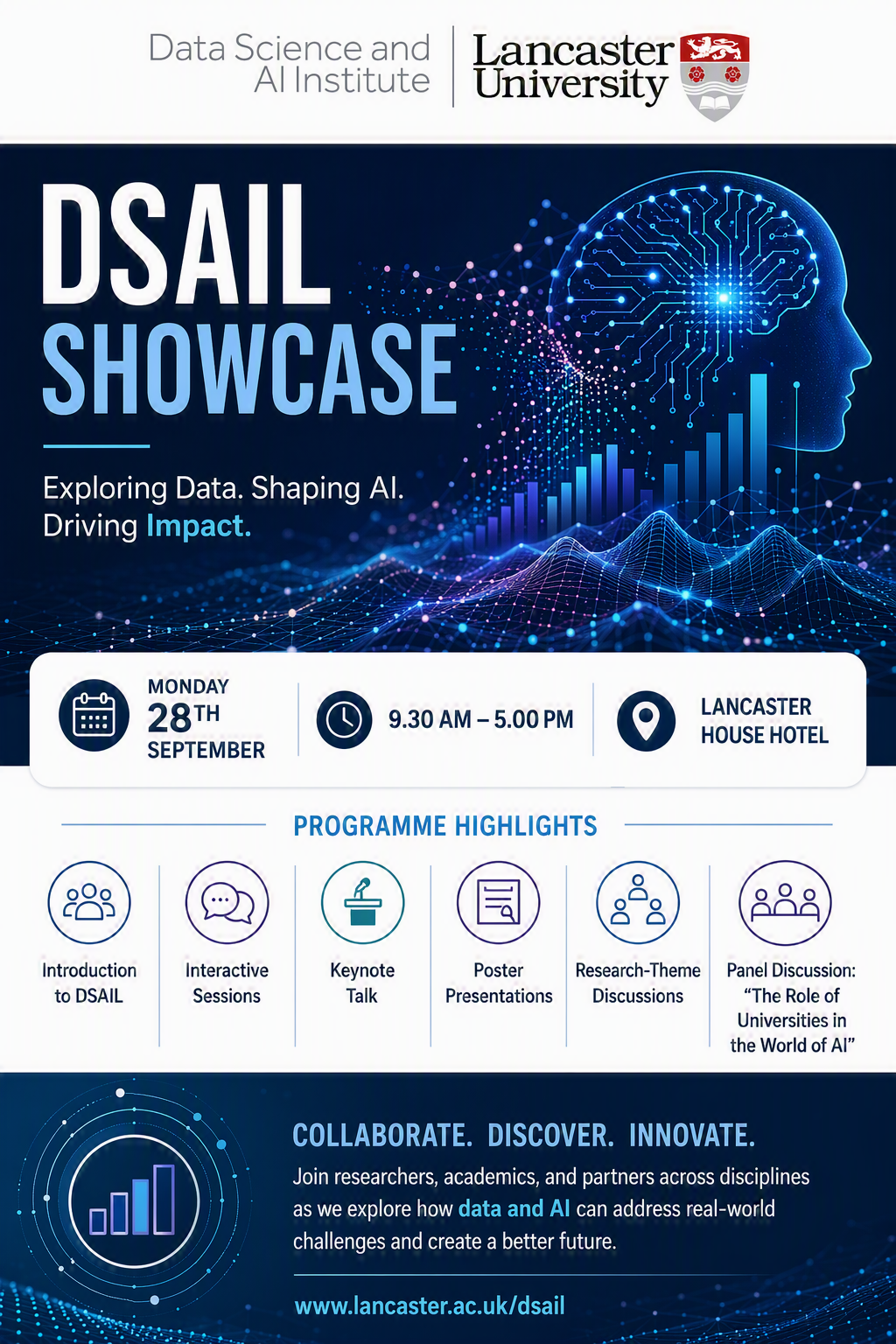
The student will be based in the School of Engineering and embedded in Lancaster’s Data Science and AI Institute. They will work across robotics, AI and communications, with access to Lancaster robotics facilities, including remote manipulation platforms, human-robot interaction interfaces, simulation environments and mobile robotic systems. The student will also be part of the DSAIL doctoral cohort, which brings together AI and data-science PhD students from across the university through cohort training, research events and interdisciplinary networking.
Training and skills: Supervision is interdisciplinary, spanning robotics, AI, wireless communications, human-robot interaction and safety-critical systems. The student will develop skills in probabilistic and uncertainty-aware machine learning, multimodal human-robot interaction data analysis, communication-aware autonomy, ROS/ROS2 robotic programming, digital-twin validation, constrained control and experimental robotics. Outputs from the project are expected to target leading robotics, AI and cyber-physical systems venues.
Application details: The successful candidate will hold, or expect to obtain, at least an upper-second-class honours degree, and ideally a Master's, in Engineering, Computer Science, Robotics, Artificial Intelligence, Control, Communications, Data Science or a closely related quantitative discipline. Strong programming skills in Python, MATLAB, C++ or similar are expected. Experience or strong interest in robotics, machine learning, probabilistic modelling, human-robot interaction, control systems, communication networks, ROS/ROS2, robotic simulation or safety-critical systems would be advantageous.
Funding details: This 3.5-year full-time studentship covers UK Home tuition fees, a tax-free stipend at the UKRI minimum rate for 2026/27 (£21,805 p.a.), paid subject to satisfactory progress, and a Research Training Support Grant (RTSG) of £1,000 per year for research-related expenses, conferences and training. Additional cohort training and interdisciplinary research opportunities are provided through DSAIL.
The studentship is primarily available to home applicants. Exceptional international applicants may be considered subject to eligibility, institutional approval, and confirmation of how any fee difference would be covered.
How to apply: Please apply through the official Lancaster University application process. Instructions for applying through the University can be found at the Lancaster University Admission Portal. Applicants should include:
* An academic CV, including the names and contact details of two referees, at least one of whom should be academic.
* A two-page personal statement / cover letter explaining your motivation, relevant experience and readiness for undertaking this PhD project.
* Academic transcripts.
* Evidence of technical work where available, such as a code portfolio, GitHub repository, robotics or machine-learning project, dissertation, coursework project or publication.
* For the Lancaster University application, in place of a Research Proposal, you may upload a copy of this advertisement.
Dates
- Application deadline: TBC
- Provisional interview date: TBC
- Studentship start date: 1 October 2026
Informal enquiries: Prospective applicants are warmly encouraged to get in touch before applying. Please contact Dr Ziwei Wang z.wang82@lancaster.ac.uk for informal enquiries about the project, the supervisory team or the application process.